Chats from the past and today
It's the mid- to late 1990s. A printer—no, it's a fax machine with a printing function—is working hard, unwinding thermal paper from the roll and printing on it. It's emitting a smell in the room that has the potential to cause a headache.
The decision was made in favor of the fax machine and against the printer, because the fax didn't need toner or ink. It burned letters onto paper through heat alone, which, I only realized later, would fade over time and slowly become invisible on the increasingly brownish paper.
What I printed out, page after page, were chat logs. I had only recently discovered that this form of real-time communication existed on the net. A net that was still new to me and very, very exciting.
I could log into these chats in the browser, give myself a name, and just start writing. And that's what I did. And I thought it was all pretty cool. So cool that I thought these chats absolutely had to be archived, meaning printed out. Well…
This enthusiasm never quite left me. It even gained momentum again in the early 2000s when I discovered something that was even cooler than web chats and had actually been around even longer: IRC.
Internet Relay Chat
With an IRC client, I could dial into a server and join channels. I could assign myself a name, and if I was lucky, it wasn't already taken.
The IRC clients I used back then ran in the terminal. I don't remember exactly whether they had colored text, but that didn't matter anyway. The fact that I could open a Linux terminal and chat with other people from around the world was incredibly cool.
Not everyone shared this enthusiasm, but I didn't care. I liked the whole thing so much that during an internship, I made sure to boot up my Linux machine in the morning before driving to the editorial office.
Once there, I would open the Windows "terminal," log into my Linux computer at home, just to start the IRC client and dial in.
At that time, I ran a Linux blog and podcast. Over time, I got to know other operators of Linux sites, and we joined forces, tried to develop a kind of network from these sites, and met in IRC.
Throughout the day, we were online, often just idle, but we could ask or share something at any time, and eventually, you'd get an answer.
Later, there were more and more IRC bots that helped to use chats "better." NickServ helped to secure your own nickname so that no one else could use it. And ChanServ did the same for your own IRC channel.
I began experimenting with my own bots. Built Perl scripts and had them do silly things. I already enjoyed that back then: repurposing technologies.
Under Linux, there was the predecessor of today's LLMs: ELIZA. A program that imitated language. That worked pretty well by the standards of the time, only moderately by today's standards. The trick basically consisted of formulating a question or follow-up question from a sentence that was entered.
One of my Perl bots monitored the chat and randomly forwarded messages to ELIZA, which then generated a response that my bot then wrote back into the chat.
With this, I could fool some of my IRC friends for at least a few minutes.
It was all quite cool and fun, and so we decided that our Linux blog network should also have its own IRC network, and so we ran our own IRC servers for several months.
Eventually, the idle times became longer and longer, answers came less and less frequently, and some people were eventually not seen in IRC at all anymore. Until I eventually disappeared too. I knew many of the chatters from back then only by their nickname, so today I cannot even say what they are doing.
For me, Jabber/XMPP replaced IRC, and eventually ICQ, MSN, and later Skype also began their triumphant march. I still remember ICQ from the times when Mirabilis operated it, which is also where the logo came from. If I think about it correctly, it must have been running parallel to IRC already.
The modern heirs of IRC are probably Slack and Discord. They actually have all the IRC features: the channels, the @-notation for users, private messages, and much more.
A few weeks ago, I stumbled upon the history of IRC and was completely enthusiastic again. Much of it took place long before my internet time; I just caught the last major developments.
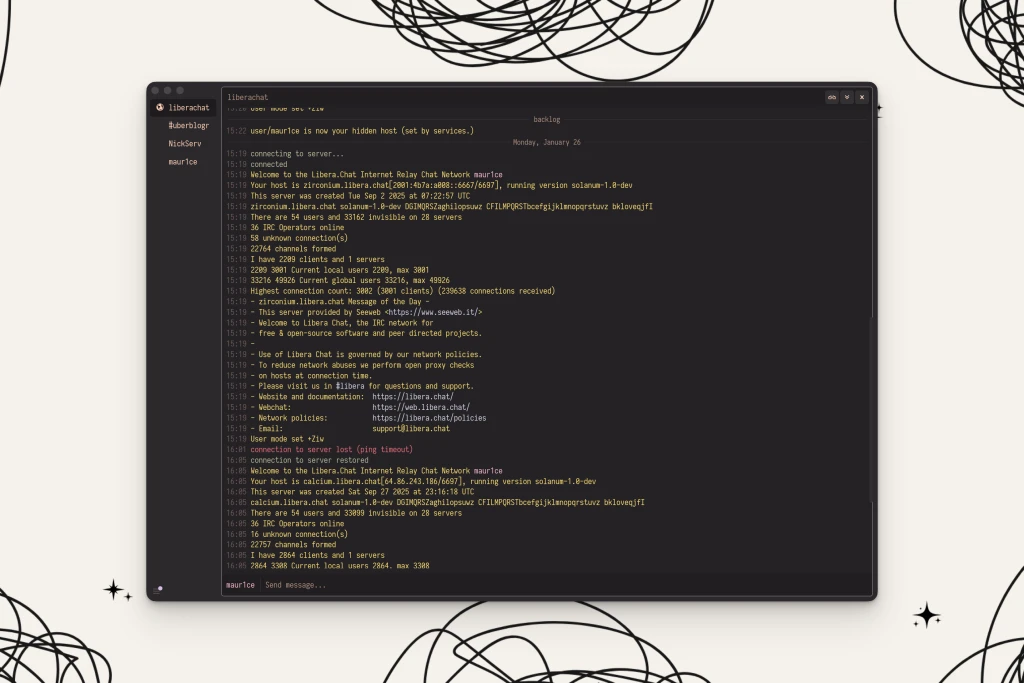
As luck would have it, I then came across UberBlogr's IRC channel on Mastodon some time ago . Of course, I had to check it out! First, I had to find out whether there were still viable IRC clients for Mac OS, and I decided on Halloy.
I stopped by the channel a few times and found some very nice people there whom I already knew from their blogs. I must confess, I then lost sight of the channel again in the everyday hustle and bustle and only remembered it through this post.
I'll probably stop by there more often again, maybe just read along a bit in idle mode and see how it evolves. When I first logged in, I definitely became very nostalgic.
But the great thing is: IRC is still alive after all these decades. Definitely check out this documentary on YouTube. Perhaps we'll see each other in the UberBlogr channel, and I promise I won't print out any chat logs—I also don't own a fax machine anymore.