About burgers and black holes
Today I learned that my burger delivery only arrives because massive black holes out there are pumping radio signals into the vastness of the universe.
The first time I consciously encountered GPS, I thought my device somehow connected to a satellite, which then shared its position with my device. I quickly learned that it doesn't work that way and is a little more complicated.
After a long day at work, you finally arrive home and decide to just order a burger, turn on Netflix, and let the day be. Then you sit on the sofa and make that one move. You know THAT move.
Every two minutes, you pick up your phone and check the status of your order. When the burger is finally ready, a probably poorly paid delivery driver puts it in his bag, hops on his bike, and rides over. That's the moment you can track your burger live on the app.
The driver most likely got your address directly through the app. Twenty years ago, he would have needed to know the city pretty well to know the fastest way to get to you. A paper map would probably have been involved, and the chance of getting a truly fresh, hot burger would have been far lower than it is today.
Because these days, the driver not only has your address, but the app will also show them the fastest route to you. And it does this using GPS. You have a fixed location, but the driver, of course, doesn't. So the maps app constantly has to determine your current position and then recalculate the fastest route back to your home.
After learning that my GPS app doesn't just connect to one satellite, I thought it used triangulation. I learned that at least three satellites must be above me. If the distance to each satellite is known, my position can be triangulated by drawing lines from each satellite, and where they intersect, that's where you are.
And I thought the satellites' positions were determined by signal strength. If the signal is weak, the satellite is far away; if it's strong, it's closer.
Well, pretty naive.
Triangulation does indeed play a role in determining my location, but it's far more complex than that. To get a truly accurate position, you first need at least four satellites. There are some magical mathematical formulas involved, and to solve them, you require at least four satellites.
I also learned that signal strength doesn't matter. Instead, each satellite transmits its current position above the Earth and its time. This information can then be plugged into the formulas to calculate where my burger is right now.
But there's a problem! The satellites' position data could become inaccurate after a while in their orbits. Even small deviations could mean your burger arrives at your neighbor's house instead of yours.
Remember those old analog grandfather clocks with the annoying ticking? They work pretty well, but after a while, the time they display becomes increasingly inaccurate. Occasionally, you have to adjust your clock; otherwise, you'll miss your bus, never meet your true love, lose your job because you're late again, and can't afford a burger anymore.
It seems there's a similar issue with satellites. They don't orbit consistently enough to rely on their initial position. So, to always know their correct position, it has to be adjusted. Just like an old clock.
This requires several ground stations. At least two. These ground stations don't move and therefore know their fixed position. As soon as a satellite passes overhead, they can transmit their current position and, in a sense, adjust it. Over and over again. Problem solved!
Or not… Because the Earth doesn't move perfectly smoothly either; it wobbles. Furthermore, the ground on which the stations are located is constantly shifting. The continental plates are always moving slightly. This means that the ground stations don't actually have a fixed position! Even these minimal deviations caused by the movement of the continental plates are enough to trigger significant discrepancies in positioning. The ground station's position must be extremely precise, but it isn't, because everything is constantly moving!
So what now?
As I mentioned, we need two ground stations. This is because we also have to calibrate the ground stations and calculate their positions.
Therefore, not only do the satellites' position data need to be adjusted regularly, but so do the ground stations' positions.
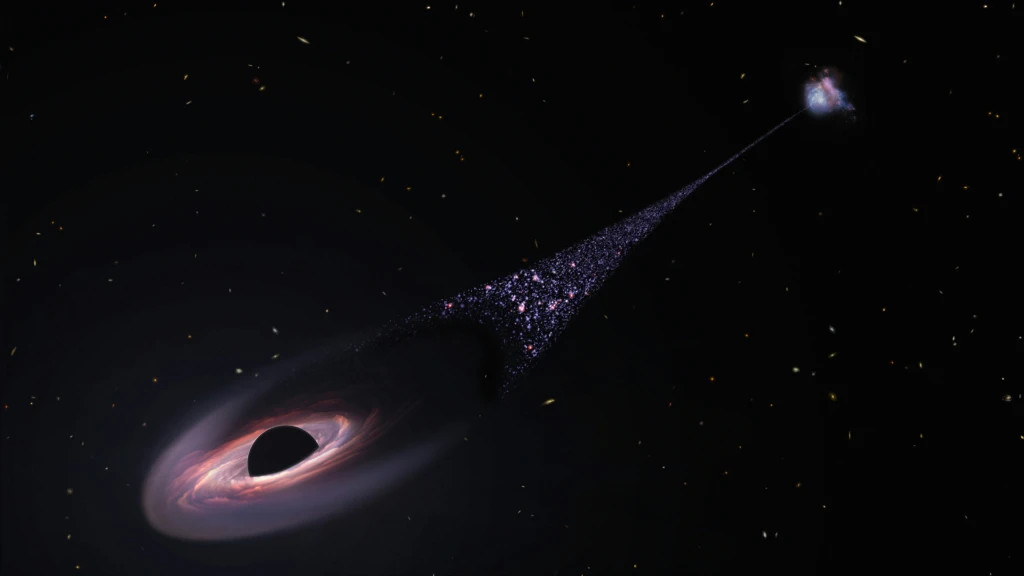
Space. The final frontier. The year is 2026. Millions of years ago, a star presumably exploded somewhere out there. We don't know exactly why, but probably because a burger was delivered to the wrong location and things spiraled out of control. There was a massive explosion, and where the star once was, there is now a massive black hole. A special kind of black hole, a quasar, that pulsates and each time it emits a radio signal into space. And it turns out there are quite a few quasars out there.
These quasars emit radio signals into space, and these signals eventually reach Earth and thus the ground stations. The radio signals reach one of the two stations before the other. The difference can be nanoseconds. But this difference makes it possible to calculate the exact position of the ground stations.
And so the circle is complete! And to be honest, I was right all along when I thought signal strength played a role. Just a little, perhaps?
But now the ground stations know their exact location and can transmit their precise position to the satellites, which in turn can relay their exact location to the driver delivering our burger.
So next time a driver pulls up to your door with a fresh burger, don't just give them a generous tip, but also pause for a moment and remember that this burger arrived so warm because black holes in space are emitting radio signals into the cosmos. So, essentially, even with our modern devices, we're still navigating by the stars.
Enjoy your burger!